5 Reasons to choose digital marketing as career
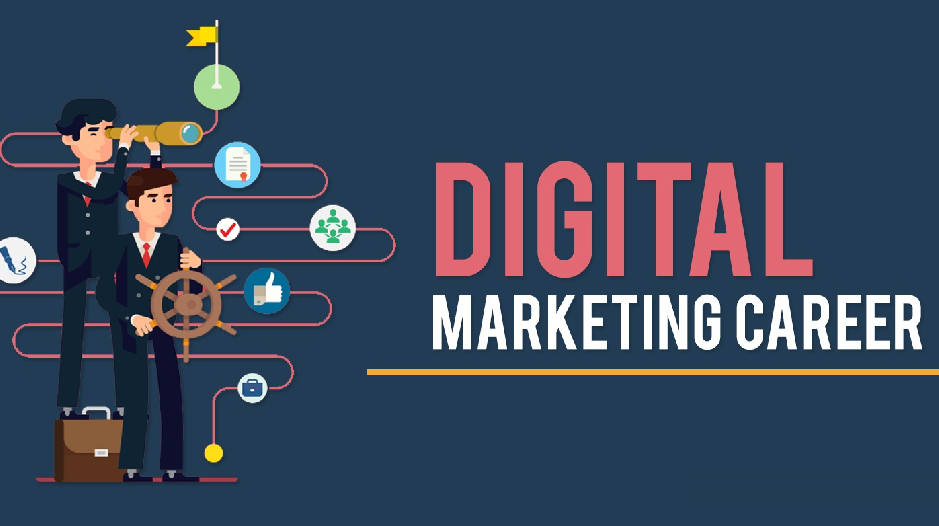
Digital Marketing Career conceptual illustration with businesses
Have you ever scrolled through your social media feed, clicked on a surprisingly relevant ad, or searched for a product online and wondered who orchestrates all of those digital touchpoints?
The answer is a digital marketer.
We are living in an era where the internet is the new global Main Street. From massive multinational corporations to the mom-and-pop bakery around the corner, every business relies on the digital ecosystem to survive, thrive, and connect with their audience. As consumer behavior has permanently shifted toward screens, the demand for professionals who know how to navigate this digital landscape has skyrocketed.
If you are standing at a crossroads in your professional life—perhaps you are a recent graduate exploring your options, a professional seeking a career change, or someone simply looking for a dynamic, future-proof field—digital marketing might just be the perfect fit.
But why, exactly, is this field generating so much buzz? Here is a deep dive into the top 5 reasons why you should consider choosing digital marketing as your career.
1. Unprecedented High Demand and Job Security
In the past decade, the question for businesses has shifted from “Should we be online?” to “How can we dominate online?” This fundamental shift has created a massive skills gap in the global job market. While companies are eager to expand their digital footprints, they often struggle to find qualified professionals who truly understand the intricacies of search engine algorithms, social media trends, and conversion rate optimization.
The Digital First Economy The rapid acceleration of e-commerce and digital services means that marketing budgets are overwhelmingly being redirected from traditional media (like print and television) to digital channels. Because of this, digital marketing is no longer just a subset of marketing; it is marketing.
Recession-Resilient: While no job is entirely recession-proof, digital marketing comes incredibly close. Even during economic downturns, businesses need to generate leads and make sales. Digital marketing is highly measurable and often more cost-effective than traditional advertising, making it the last budget cut and the first budget restored.
The Skills Gap Advantage: Because the industry evolves so rapidly—with new platforms, AI tools, and algorithms emerging constantly—there is a perpetual shortage of up-to-date talent. If you take the time to learn current skills, you will instantly become a highly sought-after asset. Companies are actively hunting for people who can bridge the gap between their products and digital consumers.
When you enter a field with high demand and low supply, you secure not just a job, but a stable, long-term career trajectory.
2. Diverse Career Paths and Specializations
One of the biggest misconceptions about digital marketing is that it is a single, monolithic job. In reality, it is a vast umbrella term that covers a wide array of highly specialized roles.
Whether you are an extroverted communicator, an introverted data nerd, a visual artist, or a persuasive writer, there is a specialized niche within digital marketing that perfectly aligns with your natural talents.
Here are just a few of the distinct paths you can take:
Search Engine Optimization (SEO) Specialist: The detectives of the internet. SEO experts optimize website content and structure to ensure a business ranks at the top of Google search results. It requires a mix of technical knowledge, content strategy, and analytical thinking.
Content Marketer & Copywriter: The storytellers. If you have a way with words, content marketing allows you to craft blog posts, e-books, video scripts, and persuasive ad copy that builds brand loyalty and drives action.
Social Media Manager: The community builders. This role is perfect for those who understand the pulse of pop culture and online trends. You’ll be the voice of a brand on platforms like Instagram, TikTok, LinkedIn, and X, focusing on engagement and brand awareness.
Pay-Per-Click (PPC) & Performance Marketer: The investors. Performance marketers manage paid advertising budgets on platforms like Google Ads and Meta Ads. They thrive on immediate results, A/B testing, and maximizing Return on Ad Spend (ROAS).
Data Analyst: The truth-seekers. Marketing is useless without measurement. Analysts dive deep into platforms like Google Analytics to track user behavior, uncover trends, and tell companies what is working and what isn’t.
Email Marketing Specialist: The retention experts. Email is still one of the highest-converting marketing channels. These specialists focus on customer journeys, newsletters, and automated campaigns to nurture leads.
Because the field is so diverse, you can easily pivot. You might start out writing blog posts (Content), realize you love diving into the traffic numbers behind those posts (Analytics), and eventually transition into an SEO Manager. The sideways mobility is practically limitless.
3. Excellent Compensation and Rapid Growth Potential
Let’s talk about a crucial factor for any career choice: the financial and professional growth trajectory.
Traditional career paths often require you to climb a rigid corporate ladder, where promotions are based on seniority or tenure rather than output. Digital marketing flips this script entirely. Because digital marketing is highly measurable, your value is intrinsically tied to the results you produce.
A Meritocracy Based on ROI In digital marketing, if you can prove that your campaign generated $50,000 in revenue from a $5,000 budget, your value is indisputable. This focus on Return on Investment (ROI) creates a merit-based environment. If you are good at what you do, you can negotiate higher salaries and advance your career much faster than in traditional roles.
Accessible Entry Level: Unlike many high-paying professions that require years of expensive postgraduate education (like law or medicine), you can break into digital marketing with certifications, a solid portfolio, and proven skills. A four-year degree isn’t always mandatory if you have the practical chops.
Lucrative Senior Roles: While entry-level salaries are competitive, the earning potential scales dramatically as you specialize or move into management. Roles like Director of Digital Marketing, Chief Marketing Officer (CMO), or highly specialized freelance consultants often command six-figure salaries.
The Freelance / Agency / In-House Choice: As you grow, you have the financial flexibility to choose how you work. You can take a high-paying in-house role at a tech startup, work on diverse accounts at a fast-paced agency, or start your own consulting business and set your own hourly rates.
When your skills directly impact a company’s bottom line, companies are more than willing to compensate you generously for your expertise.
4. Unmatched Flexibility and the "Remote Work" Lifestyle
If the idea of being chained to a cubicle from 9 to 5, five days a week, sounds like a nightmare, digital marketing offers an incredibly refreshing alternative.
By its very nature, digital marketing happens entirely on the internet. All you really need to execute a global marketing campaign is a laptop, an internet connection, and your brain. This inherent digitization has made marketing one of the most flexible professions in the world.
The Rise of the Digital Nomad Digital marketing was at the forefront of the remote work revolution long before it became a global necessity.
Location Independence: Want to optimize a website from a coffee shop in Paris? Need to launch a Facebook ad campaign from a beach in Bali? Want to analyze data from the comfort of your living room couch? Digital marketing makes this possible. Many agencies and tech companies hire fully distributed marketing teams.
Flexible Hours: While some roles require standard business hours for meetings, much of digital marketing is asynchronous and task-based. Whether you are a night owl who writes best at 2 AM or an early bird who loves scheduling social media posts at dawn, you often have the autonomy to design your own schedule, provided you meet your deadlines and KPIs (Key Performance Indicators).
Work-Life Balance: This flexibility makes it an excellent career for parents, caregivers, or anyone who values a healthy work-life balance. It allows you to integrate your work into your life, rather than forcing your life to fit around your work schedule.
5. The Perfect Blend of Creativity and Analytical Thinking
It’s a common dilemma: you consider yourself a creative person who loves writing, designing, and brainstorming wild ideas, but you also have a logical, analytical side that loves solving puzzles, looking at data, and finding patterns.
Most traditional jobs force you to choose one side of your brain over the other. Digital marketing is one of the rare fields that demands both.
The “Mad Men” Meets “Math Men” Era Modern marketing requires a beautiful synergy of art and science.
The Art (Creativity): You need deep empathy and creativity to understand human psychology. What makes someone click? What colors evoke trust? What story will make a customer feel emotionally connected to a brand? Writing captivating ad copy, designing stunning landing pages, and coming up with viral campaign ideas all require a high degree of creative flair.
The Science (Analytics): However, a beautiful ad is useless if it doesn’t convert. This is where the left brain steps in. Digital marketers use A/B testing to mathematically prove which headline works better. They dive into spreadsheets to calculate customer acquisition costs. They analyze heatmaps to see where users are dropping off on a website.
This duality keeps the job incredibly exciting. You get to be an artist conceptualizing a campaign, and then a scientist measuring its impact. It prevents burnout because you are constantly switching gears, exercising different parts of your intellect, and validating your creative instincts with hard, undeniable data.
Bonus: How to Get Started Today
If these five reasons have convinced you that digital marketing is your ideal career path, the best news is that the barrier to entry is entirely in your hands. You don’t need to wait for a university acceptance letter to start.
Educate Yourself for Free: Start with free online resources. Google offers a free Fundamentals of Digital Marketing course. HubSpot Academy is phenomenal for inbound marketing and content. Meta Blueprint teaches you everything about social media ads.
Start a Sandbox Project: The best way to learn is by doing. Start a blog on a topic you love, create a dedicated Instagram page, or build a simple Shopify store. Use this as your “sandbox” to practice SEO, writing, and social media growth.
Get Certified: Earn industry-recognized certifications (like Google Analytics, Google Ads, or HubSpot Inbound) to prove your baseline knowledge to potential employers.
Network and Apply: Join LinkedIn groups, attend virtual webinars, and start applying for junior roles, internships, or offering your services to local small businesses to build a portfolio.
Conclusion
Choosing a career is one of the most significant decisions you will make, and it pays to choose an industry that is looking toward the future, not the past.
Digital marketing offers a rare combination of explosive industry growth, lucrative salaries, geographic flexibility, and a daily mix of creative and analytical challenges. It is a career that empowers you to continuously learn, adapt, and directly see the impact of your work on a global scale.
The digital world is vast, constantly expanding, and full of opportunities. The only question left is: are you ready to log on and claim your space in it?